
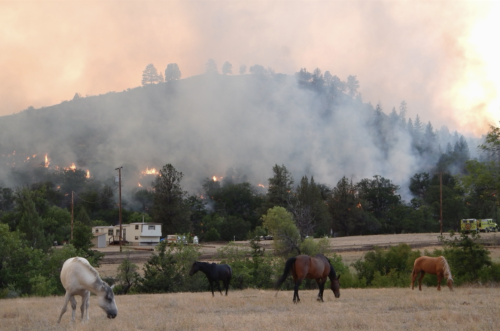
Southern California Burns Again: The 2018 Warning Agencies Ignored
In August 2018, as California and the West were already enduring massive wildfires and toxic smoke, William E. Simpson II issued a direct, detailed warning to the Department of the Interior, the Bureau of Land Management, the USDA, and the U.S. Forest Service. The press release, titled “Catastrophic Wildfire and Toxic Smoke Evolved from Ecological Imbalance,” pointed to a clear, science-supported cause: the collapse of large-bodied native herbivores had allowed fine fuels — grass and brush classified by CAL FIRE as “1-hour time-lag fuels” — to accumulate across western landscapes. These fuels ignite easily and carry fire. Logging alone, Simpson argued, would not solve the problem if the missing “nature’s brush mowers” were not restored.
He cited peer-reviewed research by William J. Ripple and colleagues: large herbivores shape the frequency, intensity, and spatial distribution of fires by altering fuel quantity and distribution. He noted that deer populations in California and Oregon had dropped by roughly two million animals compared with the 1960s–1970s. At the same time, the BLM was holding tens of thousands of wild horses in government facilities at an annual cost to taxpayers of roughly $100 million — horses that could have been grazing excess fuels in remote wilderness areas where mechanical treatment and prescribed fire are expensive, limited, or risky. Simpson offered a practical plan, the Wild Horse Fire Brigade, to pilot the rewilding of suitable horses into carefully selected remote landscapes where predators would help regulate populations and the animals could reduce fuels year-round.
The warning was not abstract. Weeks earlier, during the Klamathon Fire, Simpson had stayed on the line for nine days as an unpaid technical advisor to CAL FIRE commanders. He used local knowledge of roads and terrain to help crews. He documented free-roaming wild horses calmly grazing near the fire front on ground they had already reduced, creating open areas that served as safety zones and limited fire intensity. Those observations matched the ecological thesis he had already been developing from years of living among a local herd. The smoke permanently damaged his lungs; his wife Laura later died from complications linked to the same exposure. He was not a distant commentator. He was a citizen who put himself in harm’s way and returned with field evidence.
Eight years later, the pattern has repeated. Southern California and other regions continue to face large, wind-driven fires that generate toxic smoke. UCLA research has quantified the long-term death toll from chronic wildfire smoke exposure in California in the tens of thousands, with economic costs measured in the hundreds of billions. Additional studies have shown that wildland fire emissions of organic compounds — and the fine particles they form — have been underestimated. The underlying fuel conditions Simpson described in 2018 have not been systematically corrected through the restoration of large herbivores in the areas where they are most needed.
What explains the refusal to engage? When individuals or institutions are granted significant power and authority, a well-documented psychological dynamic often follows. Responsibility can harden into defensiveness. Outside expertise that challenges established procedures, budgets, or institutional narratives is treated as a threat rather than information. Bureaucracies develop strong incentives to protect existing programs, contracts, and public messaging even when those programs fail to address root causes. Monetary and career interests — sustained funding for roundups and holding facilities, logging contracts, prescribed-fire programs, and suppression operations — create further resistance to alternatives that reduce the need for those activities. The result is not always deliberate malice, but a structural preference for continuity over course correction. Warnings are acknowledged, if at all, then set aside.
Citizens who demonstrate practical value on the ground are effectively ghosted.
Simpson’s case illustrates the cost. A private citizen with decades of relevant experience in forests, livestock, and on-the-ground observation developed a coherent diagnosis of the fuel problem, tested it under real fire conditions, offered a low-cost pilot, and continued to refine the approach with supporting science. The agencies that control the horses, the lands, and the budgets largely declined to engage. Meanwhile, the fine fuels continue to accumulate in many landscapes, the smoke continues to harm public health, and the taxpayer costs of both fire suppression and horse holding continue.
The 2018 press release was an invitation to course-correct before the next cycle of destruction. It identified the ecological imbalance, the available animals already in government custody, the supporting science, and a specific deployment concept. That it was largely ignored does not make the diagnosis incorrect. It demonstrates how power, institutional self-interest, and the psychological insulation that accompanies authority can prevent even clear, low-risk opportunities from being tested. The fires and the smoke have not waited for that insulation to lift.
Read the Full 2018 Press Release HERE: https://www.pr.com/press-release/763424.
Visit www.wildhorsefirebrigade.org for more information.


